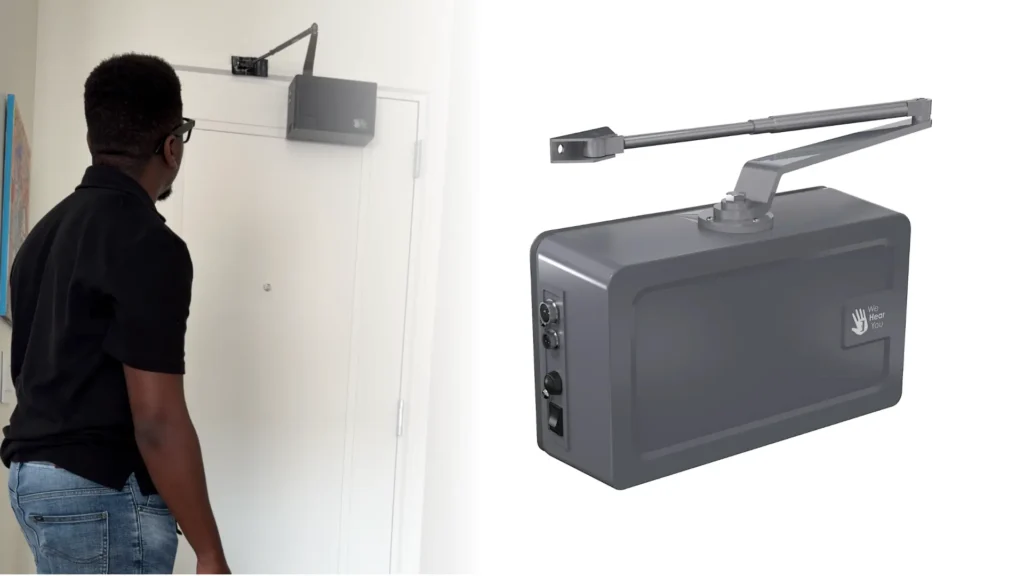
Yesterday, Pierre Paul, the CEO of We Hear You, came to my apartment to show me the HERO Door Opener in person, and I watched him mount it, plug it in, and get it working correctly in under three minutes total. That is not a typo. I have sat through enough accessibility product demos to know how rare it is for something to actually work as fast and as simply as it was promised, and the HERO Door Opener did exactly that.
What the HERO Door Opener Actually Is
The HERO Door Opener is a portable, retrofit door operator built by a company called We Hear You. Instead of the traditional model where a contractor cuts into your wall, runs wiring through your door frame, and hardwires an automatic door operator into your building’s electrical system, the HERO Door Opener can be mounted with a temporary bracket and plugged into a standard wall outlet. If a more permanent setup is preferred, it can also be hardwired, but that is a choice, not a requirement.
That distinction matters more than it sounds like it should. For a lot of us who use wheelchairs or have limited grip strength, a door is not a minor inconvenience. It is a wall. A heavy door with a spring-loaded closer can be a genuine barrier between me and a bathroom, an office, a hotel room, or my own apartment. The HERO Door Opener is built to remove that barrier without requiring a construction crew.
Watching Pierre Install It in My Own Apartment
I want to be specific about what I actually watched, because I think the details are what make this story worth telling. Pierre mounted the HERO Door Opener on my door using the temporary bracket, plugged it into the outlet next to the frame, and had it physically attached and opening the door in under two minutes. He then spent about another minute adjusting the swing speed and hold-open timing so it felt natural instead of jerky or too fast. From start to finish, my door went from manual to automatic in roughly three minutes, with basic tools and no electrician.
I have looked into automatic door openers before, for my home and for client sites during accessibility evaluations, and the traditional process usually involves an electrician, a contractor, and a bill that can run past $10,000 once you account for labor and hardwiring. The HERO Door Opener costs $2,200. That is not a small number, but it is a fraction of what most of us have been told is the only option, and it comes without the weeks of scheduling and construction that usually go with it.
The Real Cost Problem With Automatic Door Openers
Here is the part that frustrates me most as someone who has spent years advocating for accessible spaces. Businesses and property owners often want to do the right thing. They know a heavy door without an opener creates a barrier, and many of them are aware of the accessibility standards laid out in the ADA Standards for Accessible Design, which address door hardware, opening force, and maneuvering clearance. But when the estimate comes back at five figures and requires ripping into a wall, plenty of owners quietly shelve the project. The door stays heavy. The barrier stays in place.
The HERO Door Opener changes that math. A venue, a small business, or a family setting up a home for an aging parent does not need to choose between doing nothing and spending ten thousand dollars. That middle option, a $2,200 device that a general contractor, facilities manager, or honestly almost anyone with basic tools can install in an afternoon, is exactly the kind of practical solution that gets used instead of shelved.
Why This Matters Beyond My Apartment
What stood out to me most about the HERO Door Opener is how well it fits temporary and event spaces, not just permanent installations. Because it can be mounted with a bracket rather than hardwired, a venue could install a HERO Door Opener on a conference room door for a single event and remove it afterward. I have written before about how much gets missed in accessible event planning, and door access is one of the details that gets overlooked constantly, mostly because organizers assume a fix requires permanent construction. The HERO Door Opener removes that excuse.
This is also the kind of product I would want to see put through a full evaluation as part of our product testing work, where we assess how a device performs across different bodies, different disabilities, and different real-world settings, not just in a single demo. A device working well in my apartment on one visit is a good sign, but a thorough evaluation is what tells a business whether something is reliable enough to recommend to clients.
A Familiar Problem, A Different Kind of Solution
I have spent a lot of my career looking at doors specifically, because doors are where so much accessibility planning quietly fails. It is part of why I invented Door Nub®, a simple adaptive device that helps people with limb differences or limited grip strength open doors that were never designed with them in mind. Door Nub solves a different piece of the same problem the HERO Door Opener solves: doors built for a world that assumed everyone has the same strength, dexterity, and reach.
What I appreciate about the HERO Door Opener is that it approaches accessibility the same way I try to. Not with an expensive, complicated overhaul, but with a smart, affordable fix that a normal person can actually implement. The HERO Door Opener is not trying to replace a full architectural renovation. It is trying to solve the actual problem, which is that a door is closed to someone who needs it open, as quickly and affordably as possible.
Let’s Make Your Space More Accessible
If you manage a building, run events, or are trying to figure out how to make a specific door in your life easier to use, I would genuinely love to talk with you about it. Whether that means looking at something like the HERO Door Opener, walking through our inclusivity assessments, or just talking through what is actually creating the barrier in your space, reach out to our team and let’s figure it out together.