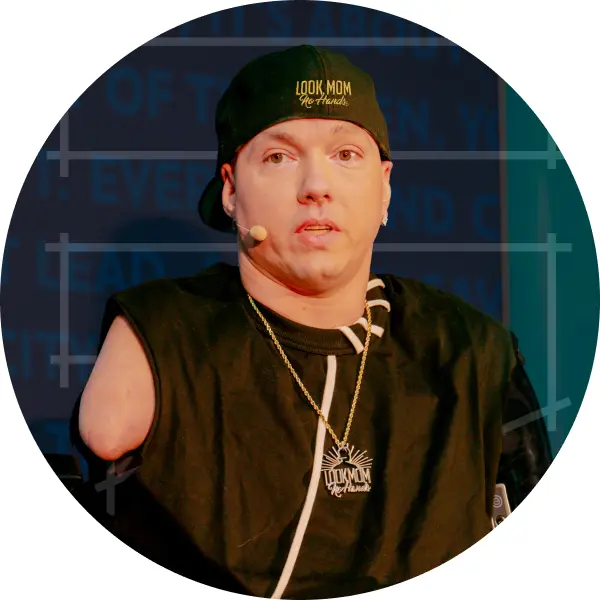
My experience with AI for people with disabilities started in a place I didn’t expect: building my first Mac app.
I have designed apps and websites for other people for most of my career, and I have been coding in HTML, CSS, JavaScript, and PHP for a long time to bring those designs to life on the web. What I had never done, not once in all those years, was build a real Mac or iOS app from scratch.
Native app development always felt like a separate world, one built around Swift and Xcode and a learning curve I never had the time or the reason to climb. AI changed that. For the first time, I could describe what I wanted to build out loud, work through problems conversationally, and turn an idea into a functioning app without spending months learning an entirely new programming language.
Why AI for People with Disabilities Changes the Starting Line
For years, building a native app meant learning a new programming language, hiring a developer, or partnering with someone who already knew that world. All three of those options take time most people do not have sitting around, especially when you already have a full plate of client work. I could design an app idea in my head down to the smallest detail, but turning that idea into something people could actually download always required starting over in a language I had never touched.
That gap is exactly where AI for people with disabilities has changed the equation. Tools that let you describe what you want in plain language, and then generate working code from that description, remove the step that used to stop me cold. And because I do not have hands, typing has always taken me longer and cost me more effort than it does most people, even after years of doing it every day for work. Being able to talk through an idea instead of typing it out line by line was not the only reason this became possible for me, but it made the whole process faster and a lot less tiring.
The Real Unlock Is Voice, Not Just AI
Here is the piece I want business owners and other people with disabilities to understand, because I think it gets buried under all the talk about AI writing code. ChatGPT and Claude both have voice-to-text built directly into the app. Not a plugin, not a separate download, not a piece of dictation software you have to buy and configure. You open the app, tap the microphone, and start talking.
That matters more than it sounds like it should. In the past, if someone could not type easily, they needed dedicated dictation software just to get words into a computer at all, and then they still needed a developer to turn those words into a working app. Now those two steps have collapsed into one. I can describe an app idea out loud, in the same voice I would use to explain it to a friend, and AI for people with disabilities becomes something you speak your way into rather than something you need two separate tools and a developer to reach.
I have built multiple Mac and iOS apps this year using exactly this process. I talk through what I want a feature to do, what a button should say, how a screen should flow into the next one, and the AI writes the code behind it. When something is not quite right, I say so out loud, and we adjust it together. There is no keyboard step in the middle anymore. AI for people with disabilities, done this way, means the distance between having an idea and holding a working app in your hand is shorter than it has ever been.
Disability Gives You a Different Set of Eyes
People with disabilities spend a lot of time solving problems nobody else in the room has noticed. We build workarounds constantly, for doors, for forms, for tools that were never designed with us in mind, and most of us do it so automatically we forget it is a skill. That skill is exactly what makes AI for people with disabilities such a meaningful shift. The barrier used to be turning that problem-solving instinct into working software. Now the barrier is a lot closer to just saying the problem out loud.
None of the apps I have built exist because a market research report identified a gap. They exist because I personally ran into a wall, the same way I have run into physical walls, doors, and counters that were not built with someone like me in mind. AI for people with disabilities means that instinct to build a workaround can now become an actual product, spoken into existence instead of staying a private fix nobody else benefits from.
This Is Bigger Than Apps
I do not think this stops at Mac and iOS apps. The same voice-driven tools that let me build software without typing a line of code are lowering the barrier for people with disabilities to start businesses, launch products, and turn lived experience into something other people can use and pay for.
Analysts have pointed out that low-code and AI-assisted development are shifting who actually builds software, with a growing share of developers now coming from outside traditional technical roles, according to Gartner’s research on low-code adoption. AI for people with disabilities is not a replacement for accessible hiring practices or inclusive workplaces, but it is one more route into building something of your own when those doors have not always been open.
This connects to work we have covered before on how assistive technology continues to evolve, and on tools like MouthPad that are redesigning what independence looks like for people with limited mobility. Voice-driven AI development belongs in that same conversation. It is not a mobility device or a communication tool, but it is removing a barrier just the same, one that kept a lot of good ideas locked inside people’s heads for a lot longer than they needed to be.
It is also part of why we built out our inclusive design and consulting work the way we did, because tools change fast and businesses need someone tracking what AI for people with disabilities actually means in practice, not just in theory.
If You Have an Idea, Just Say It Out Loud
If you are a person with a disability sitting on an idea you assumed was out of reach, open ChatGPT or Claude, tap the microphone, and start talking. Describe the app the way you would describe it to a friend at dinner. You do not need a computer science degree, and you do not need to type a single line of code, or a single word at all if typing is not something that comes easily to you. What you need is the same thing you already have: a perspective shaped by problems most people never have to think about, and now, a voice-driven path to actually building the solution.
If your business wants to think through how AI and inclusive design intersect, or you want help making sure the products you build are usable by everyone, not just the people who designed them, we would like to talk. Reach out to us and let’s talk about what AI for people with disabilities could mean for your next idea.