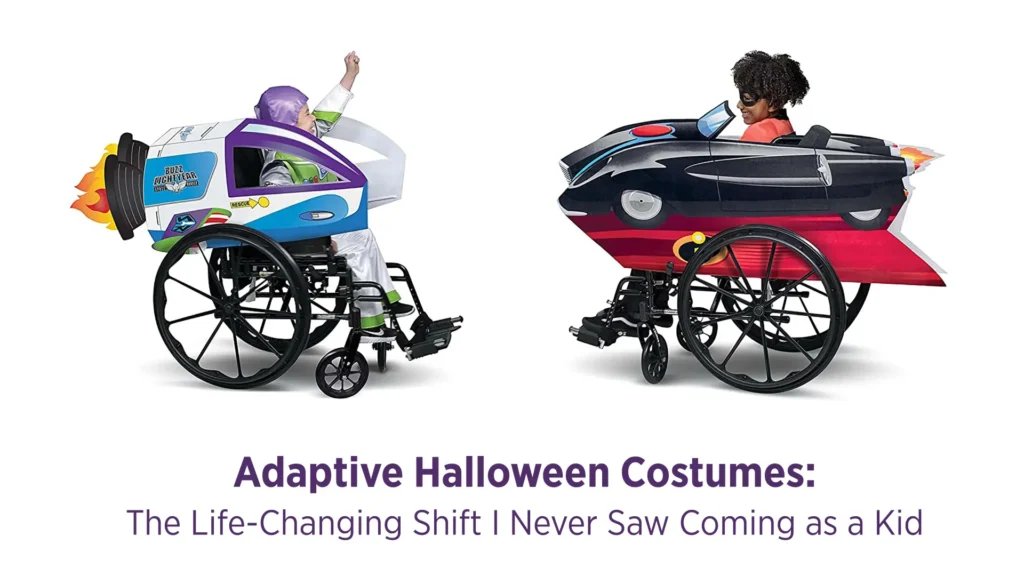
Every year around this time, I think about the costumes my parents customized for me by hand, because back then, adaptive Halloween costumes simply didn’t exist on a store shelf. If you wanted your kid in a wheelchair to be a pirate, a race car driver, or a superhero, you figured it out yourself with scissors, safety pins, maybe some duct tape, and a whole lot of patience. There was no catalog to flip through, no website to order from. My parents were the R&D department, the tailors, and the safety inspectors all rolled into one, and they did it every single October without complaint.
What Halloween Looked Like Before Adaptive Halloween Costumes Existed
I was born without hands, and used a wheelchair, so a costume that worked fine for most kids usually needed rethinking before it worked for me. A cape that dragged under my wheels. Gloves that had nowhere to go. Masks and helmets that were built for someone who could reach up and adjust them, not someone who couldn’t. My parents took whatever costume caught my eye that year and quietly reworked it so I could actually wear it and actually play in it, not just pose for a photo on the porch.
Growing up, I faced numerous obstacles in a world not designed for people in wheelchairs, limb differences, and people with disabilities in general, and Halloween was a small but real example of that every year. It wasn’t just the sidewalks and the stairs I’ve written about before. It was the costumes themselves. Nobody was designing for a kid like me, so my family designed around me instead.
The Retailers Catching Up
That’s what makes this moment feel like such a shift. Stores like Target now carry a dedicated adaptive Halloween costume line built for kids who use wheelchairs, feeding tubes, or who need sensory-friendly fabric without tags, seams, or scratchy materials. Halloween Express has a section built specifically around adaptive wheelchair costumes, with designs that turn the chair itself into part of the costume instead of something to hide or work around. HalloweenCostumes.com has done the same, offering wheelchair covers and adaptive pieces that are actually designed from the start for kids with disabilities, not retrofitted afterward by a parent at the kitchen table.
None of that existed when I was little. If it had, my mom and dad would have had a few less late nights before October 31st. I don’t say that as a complaint about the past. I say it because it shows real progress, and I want other parents raising kids with disabilities to know these options are out there now, so they don’t have to reinvent the wheel every single year the way my family did.
Why Adaptive Halloween Costumes Matter Beyond the Costume Itself
Adaptive Halloween costumes aren’t just about fabric and fit. They’re about a kid getting to be exactly what they imagined for one night, without a workaround, without an adult explaining why the mask doesn’t quite fit right, without feeling like an afterthought. A costume seems small in the grand scheme of accessibility, but for a kid, it’s everything. It’s identity, imagination, and belonging, all wrapped up in polyester and glitter.
When a store puts real thought into adaptive Halloween costumes, it sends the same message I talk about constantly in my work at Equal Accessibility: you were thought of, not squeezed in as an afterthought. That’s the same standard we push businesses toward in our product testing services, because a product built with disability in mind from the start almost always works better for everyone, not just the customer it was originally designed for.
I’ve written before about what it took to get an accessible Halloween off the porch and onto the sidewalk, and about how growing up in a non-inclusive world shaped the mission behind everything I do now. Adaptive Halloween costumes fit right into that same story. They’re proof that when companies actually listen to disabled kids and families, the products get better, not more complicated.
Reviewed, the product review outlet owned by USA Today, has covered how far adaptive and wheelchair Halloween costumes at Disney, Target, and more have come in just the last few years, and it’s worth a look if you’re a parent trying to figure out where to start this season.
What I’d Tell My Younger Self
If I could talk to the version of me getting dressed up as a kid, sitting still while my mom pinned fabric around my chair, I’d tell him this gets easier. Not perfect, not solved, but easier. There’s a whole industry now that didn’t used to think about kids like him at all, and some of the biggest retailers in the country are finally building costumes with disabled kids in mind instead of leaving that job to exhausted parents.
That’s what progress looks like a lot of the time. It’s not one giant announcement. It’s a costume rack at Target that has a spot for a wheelchair cover next to the superhero capes. It’s small, and it’s also everything, especially to the kid trying it on.
Let’s Build More of This Together
Adaptive Halloween costumes are a great example of what happens when a company designs with disability in mind from day one instead of bolting on a fix later. If your business wants to build that same kind of thinking into your products, spaces, or customer experience year round, not just in October, contact us today and let’s talk about what that could look like for you.