The Hidden Accessibility Crisis in College Testing Centers
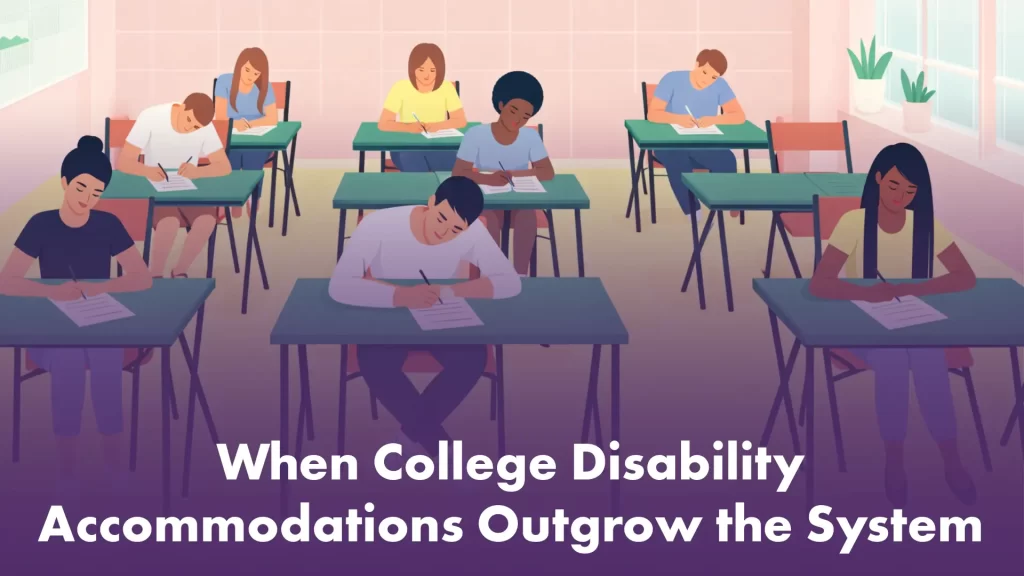
Across colleges and universities, disability accommodations and services offices are facing a growing challenge: they are running out of testing space.
Private rooms, reduced-distraction environments, and proctoring centers are stretched thin—especially during midterms and finals. What was once a manageable system has quietly become overburdened.
This issue is now part of a broader national conversation. In a January 2026 feature, The Atlantic explored how elite universities are struggling to keep pace with the rapid growth of students receiving academic accommodations. The article describes how administering exams—once relatively straightforward—has become increasingly complex as more students qualify for extended time and separate testing environments, often requiring “a distraction-free environment” as the default rather than the exception.
The growth of college disability accommodations isn’t the problem. More students are being diagnosed with ADHD, anxiety, and depression, and universities have made the process of requesting disability accommodations easier and less stigmatizing. That progress matters.
But there’s an unintended consequence that often goes unaddressed.
Students with physical disabilities are increasingly competing for the same limited testing spaces as students whose disability accommodations don’t actually require physical or environmental modifications. And when that happens, access quietly starts to break down.
The Legal Reality: Schools Cannot Rank Disabilities
Colleges cannot legally prioritize one disability over another based on diagnosis, perceived severity, or legitimacy.
Under the IDEA and Section 504, physical disabilities, learning disabilities, ADHD, anxiety, and depression are all protected. Institutions cannot decide that one condition is “more deserving” than another, nor can they restrict disability accommodations simply because more students qualify.
Where many institutions struggle is confusing equity with sameness. Treating all disability accommodations as interchangeable may feel fair on paper, but in practice it often creates new barriers—especially for students who rely on physical access to participate at all.
The Real Issue Isn’t Volume—It’s Mismatch
The core problem isn’t that too many students need disability accommodations.
The problem is that very different needs are being routed into the same physical environments.
A student who needs extended time or a quieter setting does not require the same space as a student who needs wheelchair-accessible clearance, height-adjustable desks, assistive technology, or power access for mobility or medical equipment.
Yet many campuses assign all accommodated exams to the same small pool of private rooms. When physically accessible rooms are treated as general-purpose spaces, students whose disability accommodations depend on those environments are the ones who lose access.
A Legal Solution: Prioritize by Room Requirements, Not Diagnosis
Here’s the shift colleges can make—without violating the law.
Testing spaces should be allocated based on what the accommodation physically requires, not the disability label attached to it.
This approach is already standard elsewhere. Hospitals assign rooms based on equipment needs. Hotels protect accessible rooms for guests who require them. Housing providers reserve accessible units based on functional need.
Applying this same logic to college disability accommodations isn’t discriminatory—it’s responsible design.
Tiered Testing Environments, Not Tiered Students
A legally sound approach is to create tiers of testing environments, not tiers of people.
Physically accessible testing rooms should be reserved for students whose disability accommodations require mobility-device access, adaptive or adjustable furniture, space for aides or assistive technology, or reliable power access.
Standard reduced-distraction rooms can support students whose disability accommodations involve extended time, lower-distraction settings, computer access, or scheduled breaks.
Every student still receives their approved disability accommodations. The difference is where those accommodations are delivered, not whether they exist.
Functional Needs Assessments Are Both Legal and Effective
Schools do not need to ask how severe a disability is.
They can ask what a student needs in order to access the exam and whether that need requires physical or environmental modifications.
This keeps the focus on access instead of judgment, while allowing disability services offices to use limited space more effectively. It also aligns disability accommodations with real-world use rather than assumptions.
Expanding Capacity Without Denying Accommodations
There are practical, legal ways colleges can relieve pressure on testing centers while still honoring disability accommodations.
Extended-time exams can take place in standard classrooms when feasible. Larger shared proctoring spaces can be used for time-based accommodations. Students with physical access needs can be scheduled first, with remaining rooms assigned afterward. Underused academic spaces can be repurposed during finals. Modular furniture can allow rooms to convert quickly when demand spikes.
None of these strategies reduce disability accommodations. They simply ensure that physically accessible environments remain available to students who rely on them.
Why This Moment Matters
Students with physical disabilities already navigate campuses that were not designed with them in mind.
When accessible testing rooms are unavailable—because they’ve been absorbed into general-use accommodation pools—access turns into exclusion, even if unintentionally.
This isn’t about questioning invisible disabilities. It’s about making sure physical accessibility doesn’t become collateral damage as disability accommodations continue to expand across higher education.
A Smarter Path Forward
Colleges don’t need to choose between students. They need to design better systems.
By aligning testing environments with functional needs, protecting physically accessible spaces, and planning for growth, institutions can remain legally compliant while delivering on the promise of inclusion.
The growth of disability accommodations isn’t the crisis. The lack of thoughtful design is.
Let’s Fix the System, Not Just Manage the Symptoms
If your institution is struggling with testing space, proctoring capacity, or the equitable delivery of disability accommodations, this is a design problem—not a people problem.
At Equal Accessibility, we work with colleges and universities to identify real-world barriers, evaluate how accommodations function in practice, and design systems that go beyond compliance so access doesn’t disappear when demand increases. Lets get the conversation started today.