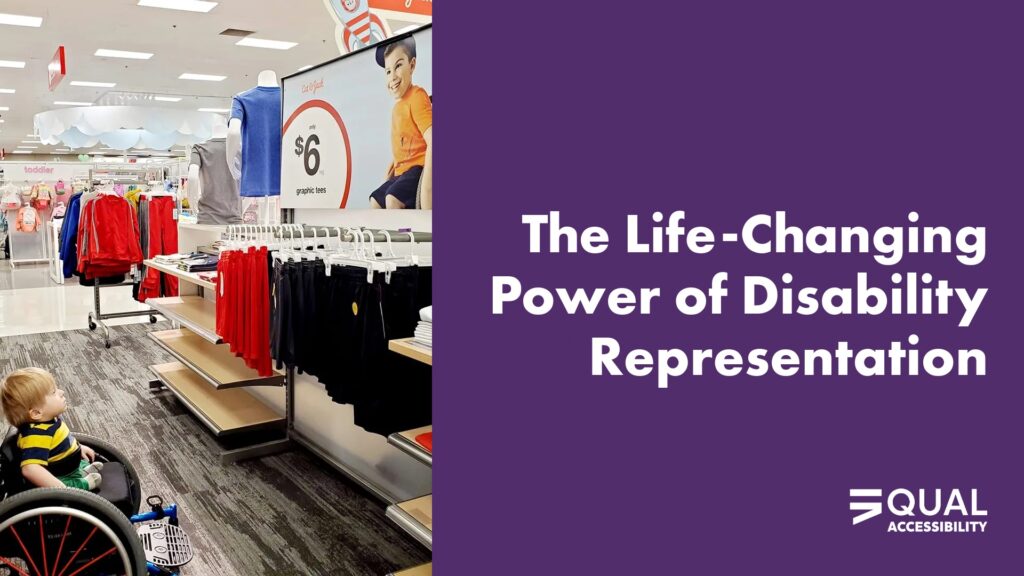
Growing up, I didn’t see anyone like me in advertisements, on TV, or in movies. Disability representation in media was almost nonexistent. As a kid who used a wheelchair and was born with limb differences, it often felt like the world of media and marketing was for everyone else. The faces I saw were able-bodied. The stories I watched were about people who could walk, run, and climb stairs without thinking twice. Representation matters, but at the time, I didn’t even know how deeply it mattered because I didn’t have the chance to experience it.
When you never see yourself reflected back, it creates this unspoken message: maybe you don’t belong in the picture. Maybe you’re not supposed to be part of the story. That absence shapes how you view yourself and how you think the world views you.
Representing A Brand In A Super Bowl Commercial
Fast forward to this year, and I had one of the most surreal experiences of my life. I had the chance to represent Rocket Mortgage in their Super Bowl commercial, and not only that—I got to do it alongside my son, Noah. To be a part of one of the biggest advertising stages in the world, with my family, showing people that disability representation has a place in the spotlight, felt like a full-circle moment. I couldn’t help but think about my younger self. What if I had seen someone like me in a Super Bowl commercial when I was 10 years old? How much sooner would I have believed that I belonged, that I could be part of something big, that my life could be full of possibilities?
The truth is, disability representation isn’t just about boosting the confidence of kids like me. It’s also about changing the way everyone else sees the world. I’ve noticed more and more brands leaning into this in recent years, and it gives me hope.
Disability Representation That Matters
Take Target, for example. Their ads often feature children with different types of disabilities modeling clothing or playing with toys. Although Target may have pulled back on parts of its DEI efforts behind the scenes, publicly they have continued to feature models with disabilities in their ads. That kind of disability representation matters. It might seem simple—a photo of a kid in a wheelchair holding a toy, or a child with Down syndrome wearing a cool new outfit. But to me, and to countless families, it’s a powerful shift. Kids with disabilities are starting to see people that look like them. They’re realizing they’re not alone, and more importantly, they’re not “different” in a negative sense—they’re simply part of the fabric of everyday life.
Normalizing Difference Instead Of Isolating It
And here’s the other side of that coin: children without disabilities are also seeing those ads. They’re learning from a young age that not everyone looks, moves, or communicates the same way, and that’s okay. Disability representation builds empathy. It normalizes difference instead of isolating it.
I think back to the networking mixers and conferences I’ve attended as an adult, where accessibility often felt like an afterthought. No ASL interpreters, tables that were too high, wheelchair seating tucked away in the corners. Those experiences remind me why disability representation is so critical. When brands and entertainment companies showcase disability as a normal part of life, it doesn’t just change what we see—it changes how society designs, how it plans, and how it includes people in real life.
For me, seeing my son Noah on screen next to me during the Super Bowl meant even more. He grew up watching me navigate a world that wasn’t built with people like us in mind. But unlike me, he’s growing up in a time when brands are finally starting to shift. He gets to witness inclusion in real time, not just in our lives, but in the wider culture. And when he sees children with disabilities in ads and commercials, he sees the world moving toward a place where inclusion is the default, not the exception.
More Than Just Checking A Box
Disability representation isn’t about checking a box. It’s about rewriting the narrative. It tells kids like me, and kids like Noah, that they are worthy of being seen. It tells families like mine that we’re part of the community. And it tells the rest of the world that diversity isn’t just race, gender, or age—it’s disability, too.
Disability representation matters because it chips away at the idea of “other.” It shows that disabled kids deserve to dream big, that adults with disabilities deserve to be in boardrooms, on stages, and yes, in Super Bowl commercials. And it helps build a generation of children—disabled and non-disabled—who grow up knowing that belonging isn’t conditional.
I wish my younger self could have seen it sooner. But I’m grateful to be part of creating it now.
Let’s Build Authentic Disability Representation Together
Disability representation isn’t just about who shows up on screen—it’s about shaping how people think, how kids grow up seeing themselves, and how communities learn to value one another. Every ad, every campaign, every story is an opportunity to show that inclusion isn’t optional, it’s essential. If your brand, event, or organization is ready to create real impact and lead with authenticity, we’d love to help you get there. Reach out to Equal Accessibility today.