Growing up, sports were always something I watched more than played.
I loved competition. I loved being part of a team, the energy of a game, and the feeling of belonging that sports can create. But when I was a kid, sports were barely an option, especially at the community level. If you were born with a disability or had limited mobility, most local recreation programs simply weren’t built with you in mind.
Adaptive sports existed, but they were often hard to find, far away, or treated like a special event instead of something woven into everyday community life. School sports didn’t know what to do with kids who didn’t fit the traditional model, and local recreation departments rarely offered adaptive options. So like a lot of people with disabilities, I adapted by sitting out.
That experience shaped how I saw myself and how connected I felt to my community. And for a long time, I assumed that was just the way it was.
What Adaptive Sports Looked Like When I Was a Kid
When people talk about adaptive sports today, there’s sometimes an assumption that opportunities have always been there and we just didn’t take advantage of them. That wasn’t reality for many of us.
Most adaptive sports programs were isolated or competitive-focused, not recreational. If you wanted to participate, you needed transportation, specialized equipment, time, and parents who could navigate systems that weren’t designed to be easy. Community recreation programs, the ones meant to serve everyone, were rarely part of the equation.
Organizations like Special Olympics were doing important work, but many people still fell through the cracks, especially those with physical disabilities who didn’t fit neatly into existing programs. Adaptive sports weren’t embedded into everyday community recreation the way they should have been.
The result wasn’t just less physical activity. It was missed friendships, missed confidence, and missed chances to feel included in something bigger.
How Adaptive Sports Are Showing Up Differently Today
Fast forward to today, and the landscape looks very different. Community recreation is finally starting to catch up.
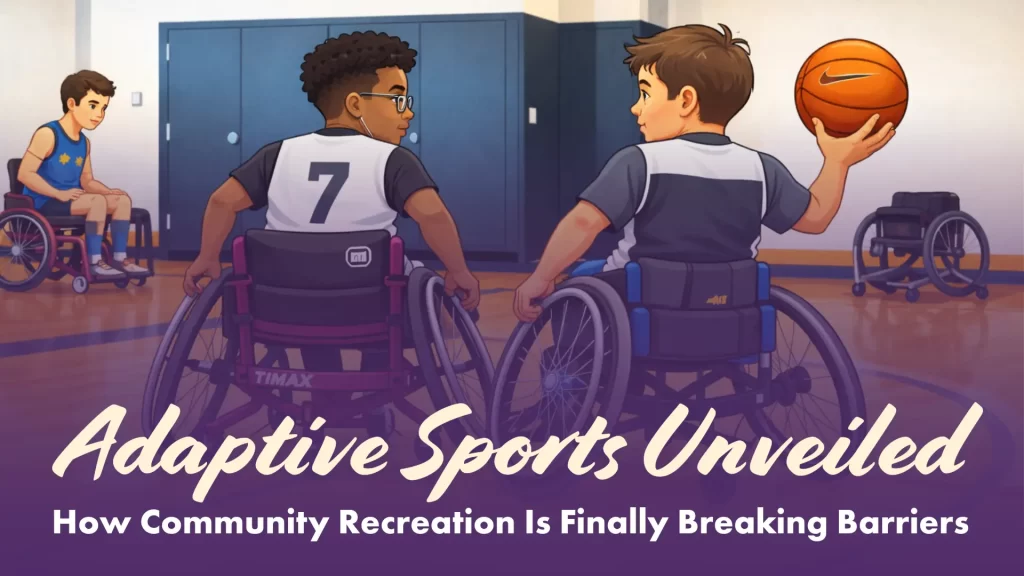
Across the country, more local programs are offering wheelchair basketball, adaptive swimming, inclusive fitness classes, sled hockey, and adaptive cycling. This shift didn’t happen by accident. National organizations like Move United have played a huge role in supporting local adaptive sports programs, training staff, and helping communities understand that inclusion doesn’t have to be complicated to be effective.
We’re also seeing greater visibility at the national level. The growth and visibility of U.S. Paralympics have helped change perceptions, showing that disabled athletes are not a lesser version. They are competitive, demanding, and worthy of investment. That visibility matters because it trickles down into communities, schools, and local recreation departments.
Adaptive sports are no longer just something you stumble upon if you’re lucky. In many places, they’re becoming a planned part of community recreation.
Why Community Recreation Is the Key to Access
Elite competition is important, but community recreation is where adaptive sports truly make a difference.
Community recreation is where kids try sports without pressure. It’s where adults rediscover movement after injury or diagnosis. It’s where families find activities they can enjoy together. When adaptive sports are offered at this level, they stop feeling like an exception and start feeling normal.
Organizations like Move United have long emphasized the importance of grassroots access. Adaptive sports shouldn’t be reserved for those who already know how to navigate complex systems. They should be easy to find, easy to try, and welcoming from day one.
When adaptive sports are integrated into local recreation programs, they also push broader accessibility improvements. Entrances, locker rooms, equipment storage, and staff training all tend to improve when inclusion is treated as standard practice instead of a special accommodation.
What Adaptive Sports Really Change
Sports do more than get people moving. They change how communities think.
When kids grow up seeing adaptive sports in their local gym or park, disability becomes familiar instead of misunderstood. Coaches learn how to adapt rules and equipment. Other athletes learn that ability exists on a spectrum. Parents see their children included instead of sidelined.
For participants, adaptive sports build confidence, independence, and resilience. They reinforce the idea that your body does not disqualify you from competition, teamwork, or joy. That mindset carries into school, work, and everyday life.
Adaptive sports also create leadership opportunities. Athletes become mentors. Parents become advocates. Communities become stronger because more people are fully participating.
Where We Still Fall Short
Even with progress, adaptive sports are still not consistently accessible.
Many programs depend on short-term funding or a single passionate organizer. Equipment can be expensive. Transportation remains a major barrier. Marketing is often limited, which means people who could benefit never hear about available programs.
Too often, adaptive sports are added as an afterthought instead of being planned from the start. And in many cases, people with disabilities are still not meaningfully involved in decision-making or leadership roles.
If we want adaptive sports to continue growing, we need to move from good intentions to long-term commitment.
How We Push Adaptive Sports Forward
Communities that truly want inclusive recreation need to treat adaptive sports as essential, not optional.
That means budgeting for them, training staff, and partnering with disability-led organizations. It means asking participants what works and what doesn’t. It also means focusing on entry-level access. Not everyone wants to compete. Many people just want to move, try, and belong.
Sports should be recreational first and competitive second. When participation grows, competition naturally follows.
Why This Moment Matters
Adaptive sports are at a turning point. Awareness is higher than ever. Resources are improving. The proof is already there that inclusive recreation works.
I think about how different my childhood might have been if adaptive sports had been as visible and accessible then as they are becoming now. I also think about how much better the next generation’s experience can be if we keep pushing.
Adaptive sports aren’t a trend. They’re a reflection of whether communities truly believe everyone belongs.
Let’s Build Communities Where Everyone Can Play
Adaptive sports shouldn’t depend on luck, location, or who happens to be advocating at the moment. If your organization, school, or community wants to strengthen inclusive recreation in a meaningful and sustainable way, we’re here to help.
We work with teams to evaluate current programs, identify gaps, and design adaptive sports and recreation experiences that actually serve the people they’re meant to include. Let’s talk today and figure out how we can help you with your programs.