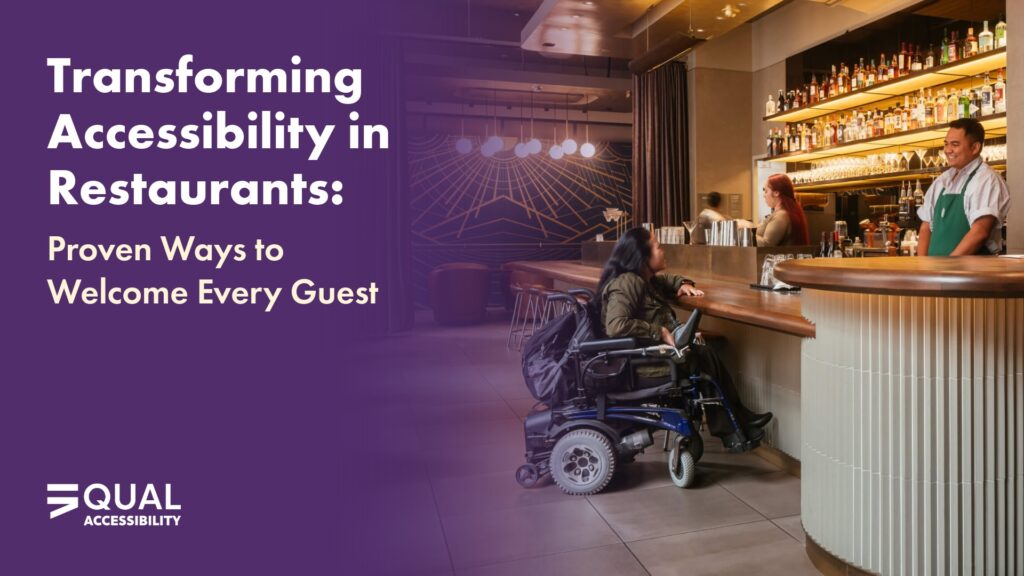
When people think about accessibility in restaurants, the first things that usually come to mind are ramps at the entrance or accessible restrooms in the back. While those elements are important, they’re just the beginning. True accessibility means creating a dining experience where everyone—regardless of disability—feels welcomed, comfortable, and included.
As someone who uses a wheelchair, I’ve had plenty of experiences in restaurants that were technically “accessible” but far from welcoming. From being seated at a table I couldn’t roll under, to menu QR Codes I couldn’t scan, to kiosks that were placed so high I couldn’t reach, these barriers are a reminder that accessibility in restaurants is about more than compliance with the ADA. It’s about thoughtfulness, dignity, and connection.
The Challenge of Seating
One of the most common frustrations I run into is seating. I’ve been in restaurants where every open table was a high-top, or the standard tables were crammed so close together that there was no way to maneuver my wheelchair. On more than one occasion, a host tried to seat me at a booth without realizing that it was impossible for me to transfer into it.
These moments are uncomfortable not just because of the physical barrier, but because they make me feel like I don’t belong in the space. That’s why seating is such an essential part of accessibility in restaurants. Owners can improve this by:
- Ensuring a portion of tables have enough clearance underneath for wheelchairs.
- Spacing tables so people can move freely without bumping into others.
- Offering a mix of seating options—booths, standard tables, and low tables—to accommodate different needs.
Something as simple as a thoughtfully placed table can turn an awkward experience into a positive one.
Menus and Ordering
Ordering is a huge challenge for many people with disabilities at restaurants. Menus in tiny print are almost impossible to navigate in dim lighting. I’ve been handed digital tablets where the buttons were too small or not accessible by touch. And at self-service counters, I’ve sometimes struggled to reach the ordering screens at all.
I’ve learned that this is a common issue for people with low vision, dyslexia, or limited dexterity too. This is where accessibility in restaurants requires creativity. Better approaches include:
- Providing large-print or braille menus.
- Offering digital menus that are screen-reader friendly.
- Training staff to read or explain menu options when requested.
- Ensuring kiosks and tablets are mounted at heights that work for everyone.
Restaurants often overlook this, but when ordering is stressful, it sets the tone for the whole experience.
Learning from Chick-fil-A
In fact, I recently wrote about my experience with Chick-fil-A’s drive-through. For me, going through a drive-through independently has always been difficult because I can’t reach out the window to grab my food. But Chick-fil-A had a process where employees brought the food directly to me instead of expecting me to adapt to their system.
That small adjustment may not seem like much, but for me, it was life-changing. It gave me independence and dignity in a way that most drive-throughs don’t. It’s a perfect example of how rethinking service—not just the physical space—can make accessibility in restaurants more inclusive.
Sensory-Friendly Dining
Accessibility in restaurants isn’t just physical—it’s sensory too. I’ve been in restaurants so loud I could barely focus on conversations, and I know many neurodivergent people who find environments like that overwhelming.
Simple adjustments can make a big difference, such as:
- Offering quiet dining hours with reduced noise and dimmed lighting.
- Minimizing background music volume.
- Training staff to be patient and respectful of different communication styles.
These adjustments help not only people with disabilities but also parents with small children, older adults, and anyone who simply prefers a calmer atmosphere.
Service with Inclusion in Mind
Even when the physical environment is accessible, staff interactions can make or break the experience. I’ve had servers who spoke only to the person I was with, ignoring me altogether, as if my disability made me invisible. Other times, I’ve had hosts insist on seating me in a spot that didn’t work, despite my objections.
Restaurants that truly value accessibility in restaurants train their staff to:
- Greet and address all guests directly.
- Ask about seating preferences rather than assuming.
- Be aware of service animals and treat them appropriately.
- Know how to assist respectfully when someone requests help.
Hospitality is at the heart of dining out, and inclusivity should be part of that hospitality.
Beyond the Basics
At its core, accessibility in restaurants is about more than ramps and restrooms—it’s about creating an environment where people of all abilities can share in the joy of dining. Whether it’s a family meal, a date night, or a business lunch, everyone deserves the same chance to enjoy the experience without unnecessary barriers.
Restaurants that go beyond the basics not only expand their customer base but also show that they care about people. Accessibility isn’t just the right thing to do—it’s also good business.
Need Help Making Your Restaurant Accessible?
If you own or manage a restaurant and want to learn how to make your space more accessible, we can help. At Equal Accessibility, we work with businesses to move beyond compliance and create environments that make every guest feel welcome. Get in touch with us today.