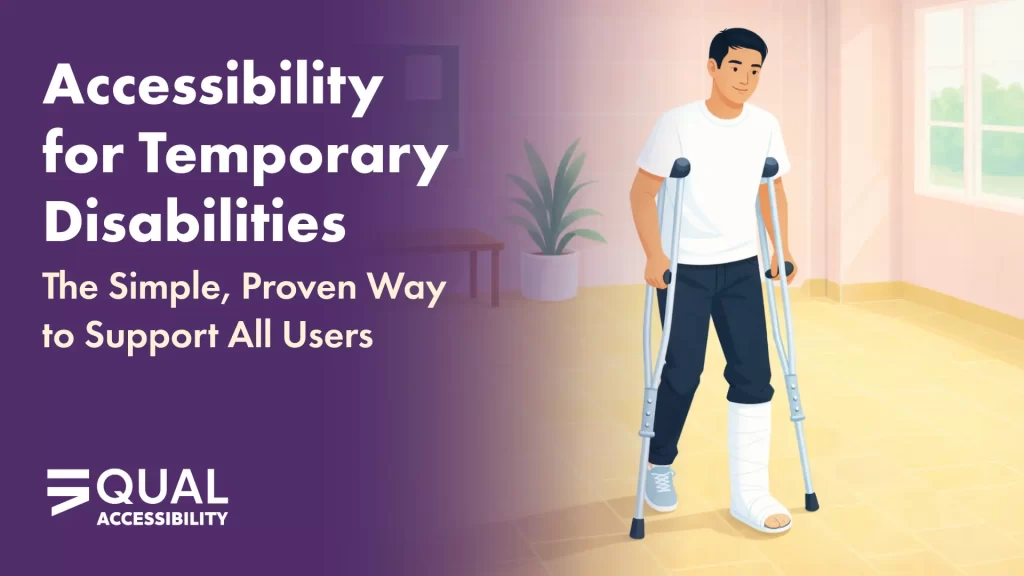
Accessibility for temporary disabilities is one of the most overlooked parts of inclusive design. When people hear the word “accessibility,” they often think only about permanent disabilities. Wheelchairs. Blindness. Deafness. Lifelong conditions.
But here’s the reality. Almost everyone will experience a temporary disability at some point in their life. A broken arm. A torn ACL. Post-surgery recovery. Pregnancy complications. A concussion. Even something as common as severe vertigo or carpal tunnel can temporarily change how someone moves, sees, hears, or interacts with the world.
If your space, website, or service only works for people at their physical best, it is not truly accessible. Accessibility for temporary disabilities is about recognizing that ability exists on a spectrum and that it changes over time. Designing with that reality in mind does not just help a few people. It helps everyone.
What Counts as a Temporary Disability?
A temporary disability is any short-term condition that limits a person’s ability to perform everyday tasks. These limitations can affect mobility, strength, vision, hearing, cognition, or stamina.
Some common examples include:
- A broken arm that makes typing or opening doors difficult
- Knee or ankle injuries requiring crutches or a walking boot
- Surgery recovery that limits lifting, reaching, or standing
- Vision changes after eye surgery
- Concussions that impact memory, focus, or light sensitivity
- Pregnancy-related mobility or balance challenges
- Severe illness that causes fatigue or shortness of breath
Accessibility for temporary disabilities acknowledges that these experiences are normal parts of life, not edge cases.
Why Accessibility for Temporary Disabilities Is Often Ignored
Most accessibility standards and conversations focus on permanent conditions, which makes sense. These are critical needs that must be met. But the unintended result is that temporary disabilities are treated as optional or rare.
They are not rare.
At any given time, a huge portion of your audience, customers, employees, or visitors may be dealing with short-term limitations. The difference is they may not identify as disabled. They may not request accommodations. They may just struggle quietly or avoid your space altogether.
When accessibility for temporary disabilities is missing, people often blame themselves instead of the environment. They think, “I’ll just come back later,” or “This place isn’t for me right now.” That is a loss you never see on a spreadsheet.
Temporary Disabilities Reveal Design Gaps Fast
One of the clearest signals that something is poorly designed is how it performs when someone is temporarily limited.
Think about these situations:
- Can someone with one usable hand open your doors, navigate your website, or complete a form?
- Can someone moving slowly or using crutches get through your space without feeling rushed or unsafe?
- Can someone experiencing brain fog understand your instructions or signage without confusion?
- Can someone sensitive to light or sound comfortably remain in your environment?
Accessibility for temporary disabilities acts like a stress test. If your design only works when users are fully able-bodied, it is fragile by default.
Digital Accessibility and Temporary Disabilities
Temporary disabilities show up just as much online as they do in physical spaces.
A person with a wrist injury might rely on voice dictation instead of a mouse. Someone recovering from a concussion may need reduced motion, clear layouts, and simple language. Someone dealing with eye strain after surgery may need larger text and stronger contrast.
Accessibility for temporary disabilities in digital spaces includes:
- Clear keyboard navigation
- Simple, consistent layouts
- Readable font sizes and contrast
- Avoiding unnecessary motion or flashing elements
- Allowing extra time to complete tasks
- Plain language instead of dense jargon
These improvements help people with permanent disabilities, temporary disabilities, situational limitations, and even people who are just tired or distracted.
Physical Spaces Matter Just as Much
Temporary disabilities make everyday environments harder than most people realize.
A single step at an entrance might be manageable for someone on a good day, but impossible for someone on crutches. Heavy doors become major barriers when one arm is immobilized. Tight seating layouts turn into obstacles when someone needs extra room to maneuver.
Accessibility for temporary disabilities in physical spaces often includes:
- Step-free entrances and smooth transitions
- Automatic or low-resistance doors
- Seating options with arms and without arms
- Clear pathways without tight turns or clutter
- Accessible restrooms that are easy to reach and use
These are not luxury upgrades. They are basic signals that your space was designed for real people, not idealized bodies.
Temporary Disabilities Affect Business, Whether You See It or Not
When accessibility for temporary disabilities is missing, people do not always complain. They just leave. They cancel appointments. They abandon purchases. They choose competitors that feel easier to navigate.
On the flip side, when people feel supported during a vulnerable moment, they remember it. They tell others. They come back when they are fully recovered.
Accessibility builds trust. Accessibility for temporary disabilities builds loyalty.
Designing for Temporary Disabilities Is Designing for the Future
One of the biggest mindset shifts we encourage is this: accessibility is not about helping “other people.” It is about future-proofing your experience.
Every person who is currently non-disabled is a potential future user with access needs. Injury, illness, aging, and life events are unavoidable.
When you invest in accessibility for temporary disabilities, you are investing in your future self, your future customers, and your future employees.
Where Many Organizations Get It Wrong
A common mistake is treating accessibility as a checklist instead of an experience. Another is assuming accommodations only happen after someone asks.
People with temporary disabilities often do not know what to ask for. They may feel awkward requesting help. They may not even realize an accommodation is possible.
Proactive accessibility is always more effective than reactive fixes.
How to Start Supporting Temporary Disabilities Today
You do not need to redesign everything overnight. Start by asking better questions:
- What would this experience feel like with one hand?
- What if someone moved at half speed?
- What if someone had trouble focusing or remembering steps?
- What if standing for long periods was not an option?
Walk through your space or website with those questions in mind. You will quickly see opportunities to improve accessibility for temporary disabilities in meaningful ways.
Related Reading
If you want to go deeper, we recommend reading our article on inclusive design and everyday accessibility, which explores how small design decisions can have a big impact across many different user experiences. It pairs well with this conversation and expands on practical ways to build accessibility into daily operations.
Ready to Make Accessibility Work for Everyone?
Accessibility for temporary disabilities is not an extra. It is a core part of creating environments, services, and experiences that actually work in the real world.
If you want help evaluating your space, website, or customer journey through a more inclusive lens, we would love to help.
Let’s Talk About What Accessibility Could Look Like for You
Start a conversation with our team and take the next step toward building experiences that support everyone, at every stage of life.